
Lander County Three-Day Release Source
The Lander County Sheriff does not maintain a separately branded 72-hour release page. The Sheriff-linked CitizenRIMS portal supplies current and historical inmate data from the agency’s systems. Its detailed booking records can display a Released status and an exact out date and time. Build the three-day result by comparing those times with a defined 72-hour interval.
Do not treat every visible released record as recent. CitizenRIMS retains released bookings beyond three days, and the visible search controls focus on booking data rather than a ready-made release window. The reviewed Sheriff sources do not promise a publication rhythm or a set retention period. The out timestamp, checked against the chosen interval, is what places an entry inside or outside the review.
Build Lander County 72-Hour Releases
A good three-day search has firm boundaries. Start with the exact time of the review, then count back 72 hours. This creates a rolling interval. If the goal is three calendar dates instead, state that choice and do not call it a rolling 72-hour set. The two methods can produce different results near midnight.
- Open the Lander County CitizenRIMS portal and note the time of the search.
- Find a likely record and open the full booking detail rather than relying on a summary.
- Match the person with the booking number, dates, and listed agencies.
- Read the status and exact out date and time.
- Include the record only when that out timestamp falls inside the stated three-day period.
- Resolve unclear release types, transfers, or missing entries through Detentions and the proper court or receiving agency.
Record the boundary and source with any notes. If another person repeats the check later, the rolling period will have moved. For an event from the present day, the Lander County 24-hour releases method narrows the same portal to a shorter range.
Lander County 72-Hour Release Fields
The portal provides enough detail to identify a booking and time its end. It may not supply every fact needed to explain the outcome. Read the record as a set. An arresting agency can differ from the booking agency, and a charge row can outlive a later dismissal or change. The court docket controls the final case outcome.
| Field | Use in a 72-hour review |
|---|---|
| Booked name and booking number | Link the event to one booking and reduce common-name mistakes. |
| Booking date and time | Show the start of the local custody entry, not the release date. |
| Released status | Indicate that the portal treats the booking as ended. |
| Out date and time | Determine whether the release falls within the exact 72-hour bounds. |
| Booking and arrest agencies | Identify the agencies tied to the custody and arrest events. |
| Charge and bail rows | Provide booking context while leaving the final case outcome to the court. |
| Disposition or destination | When shown, help distinguish release to the community from transfer. |
A desired destination or release reason may be absent. Do not infer it from the charge, bond total, or fact that an entry now says Released. Seek the Sheriff’s release log or transfer record and check the related court file.
Note: A booking allegation is not a conviction, and a Released label is not a complete statement of the court disposition.
Lander Weekend Release Review
The wider period is useful after a weekend because it reduces the chance that a Saturday event falls outside a Monday same-day check. It also helps when the person checking does not know which of several recent dates holds the release. No official Lander source says weekend entries follow a special schedule, however. Avoid claiming a guaranteed delay, a routine release hour, or a holiday posting rule.
Set the window from the actual search time. Review each out timestamp that falls inside it, then verify any event that affects a ride, court appearance, or contact plan. If a record does not appear, call Lander County Detentions at 775-635-1489. The local office, rather than a general portal assumption, can address the specific custody event.
A wider interval does not cure an ambiguous status. A transfer on Friday and a community release on Sunday are different events. Look for a disposition or receiving agency. If the public record lacks one, request it.
Why Lander Release Results Stay Visible
CitizenRIMS preserves historical Lander County bookings far beyond 72 hours. This makes the portal more useful than a list that vanishes after three days, but it also places the burden of date comparison on the reader. A Released badge alone does not qualify an entry for the current window.
Historical retention can help recover an event found late. It also supports comparison with court and agency records after the immediate release period has passed. Yet the Sheriff has not published a guaranteed online-retention span in the reviewed sources. Do not promise that a record will remain available for a set term. Save the booking number and out time needed for a later focused request.
The manifest image was captured from the Lander County historical inmate source.
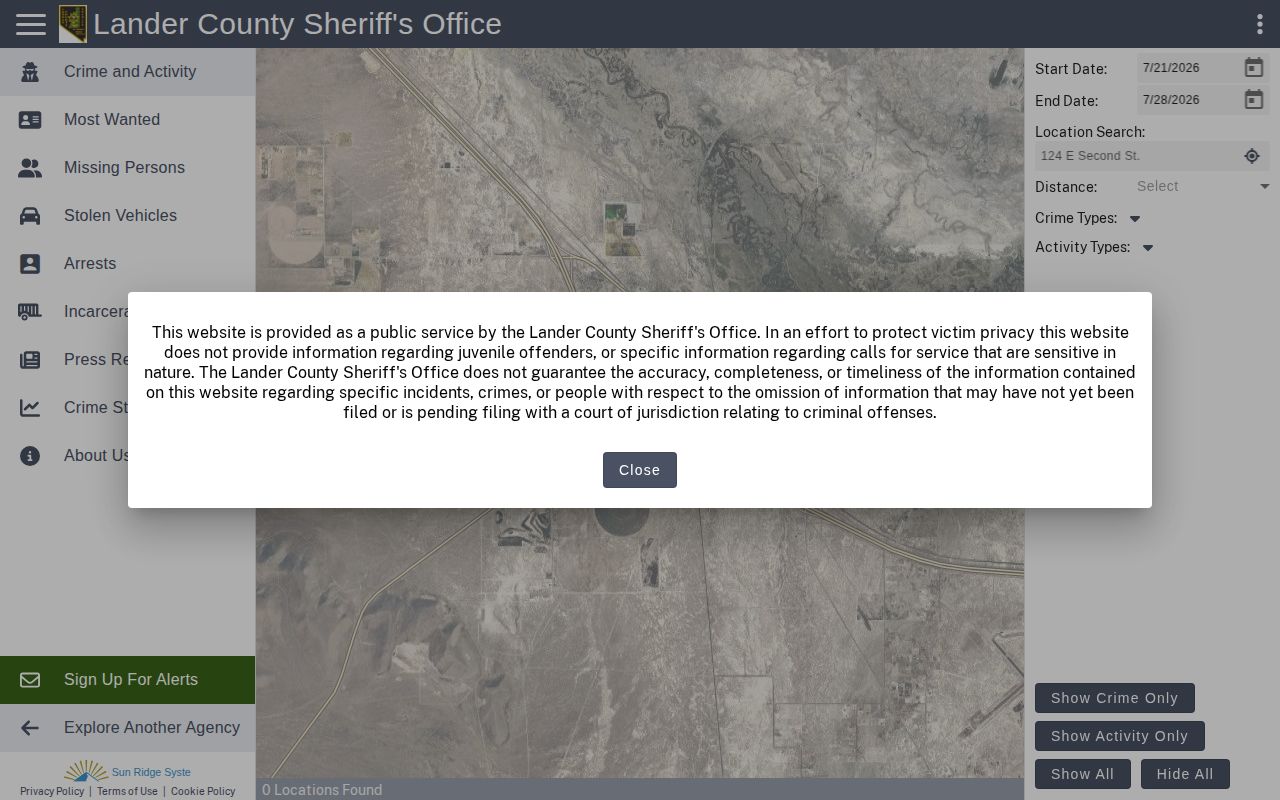
The portal view supports a three-day timestamp review, but it does not present a separate official 72-hour release feed.
Request Lander Three-Day Release Records
When the portal does not answer the question, make a narrow Sheriff request under NRS Chapter 239. Give the full three-day interval, including start and end dates and times. Identify a person or booking when known. Ask for the booking sheet, custody-status or release log, release time, release disposition, and receiving agency or transfer destination if public.
Request electronic copies and ask for an estimate before chargeable work. The research does not establish a Lander County fee, fixed response promise, or release-record retention rule. The Sheriff must apply public-record law and any confidentiality or sealing restriction to the specific material. A precise request avoids making claims about terms the source does not publish.
For case meaning, use the court that holds the matter. Argenta Justice Court serves the Battle Mountain township. Austin Justice Court serves its township. Lander County District Court, within the Eleventh Judicial District, holds district-level matters. A lower-court docket may show early bond activity; a later district record can show judgment or sentence.
Route Lander Release Checks Correctly
The right fallback depends on where the person went. CitizenRIMS and Lander County Detentions cover the local jail event. NV S.A.V.E. can provide custody-change notices for participating Nevada agencies, but automated data should be confirmed with the agency that owns the record. A notice is useful, not final proof.
| Situation | Primary confirmation path |
|---|---|
| Local booking still open | CitizenRIMS status and Lander County Detentions. |
| Lander release or transfer | Released entry plus Sheriff release log, disposition, or transfer record. |
| State-prison transfer | Nevada Department of Corrections search after intake, then NDOC records if needed. |
| Federal custody | BOP locator after commitment, or the U.S. Marshals Service route for a pretrial detainee. |
| Legal case outcome | The proper Lander justice court or district court docket and order. |
Disappearance from the live roster is not proof of community release. Nor is absence from a federal or immigration locator a historical release record. Match the system to the custody type and seek the event record from the agency that made it.
Note: NDOC becomes the next search only after a state transfer; it does not replace the Sheriff record for a county-jail release.
Interpret Lander Release Dispositions
“Release” has several meanings in a three-day review. Bond, release on recognizance, time served, dismissal, a court order, probation, parole, sentence expiration, and transfer can all end one custody entry. Parole means release from prison while supervision continues. Probation is court-ordered community supervision and may be imposed without a prison release. A transfer ends Lander’s physical custody but does not end custody as a whole.
- Out time
- The recorded end time for the local booking.
- Disposition
- The label describing how the custody event ended or changed.
- Transfer
- A move to another agency or facility, not necessarily release to the community.
- Discharge
- The formal end of a sentence or supervision term when the responsible authority records it.
Where CitizenRIMS lacks a final disposition, pair the out event with the Sheriff record and court docket. This prevents a charge label from being treated as a conviction and a local release from being mistaken for the end of all custody.
Extend a Lander Release Search
A three-day scan answers who appears to have left the local jail during a defined period. It does not replace a full search for one person across local, state, court, and federal systems. The Lander County released-inmate lookup follows those separate channels and explains how to request the release record. Use it when the date is uncertain or the person may have moved beyond the county system.
Public Record Search
Sponsored Results