
Lander County Date Meanings
One record can contain several dates with different legal effects. A parole eligibility date is the first point at which consideration may be possible under the governing law. It does not grant parole. A Board action may name an effective date, but release-plan approval and NDOC processing still matter. Sentence expiration or discharge refers to the end of a sentence calculation, subject to lawful changes.
- Projected date
- An estimate based on the current sentence and posted credits.
- Eligibility date
- A point when a person may be considered for parole, not a release promise.
- Actual release
- The recorded event showing the person left a named custodian.
- Discharge
- The end of the sentence or supervision obligation shown by the responsible agency.
- Detainer
- A request or process that can cause transfer to another authority instead of community release.
A pretrial detainee usually has no sentence-based release date. Bond, a court order, dismissal, a plea, or another custody hold can control when that person leaves the Lander County Detention Center. The court docket and jail record are therefore more useful than an NDOC sentence calculation for a local, unsentenced case.
Find Lander County Release Dates
First decide whether the Lander County Detention Center, NDOC, or another agency holds the person. The correct path changes with custody. Do not use NDOC merely because the case began in Nevada.
- Check the Lander CitizenRIMS record for the booking, custody status, and any exact out date and time.
- For a pending or county sentence, read the signed order and docket from the proper justice or district court.
- Call Lander County Detentions at 775-635-1489 when the local calculation or release event is unclear.
- For an NDOC commitment, search by offender ID or first and last name and read each displayed parole, booking, and release label exactly.
- Compare any Parole Board action with NDOC's current record. A grant alone is not physical release.
- Ask the responsible records office to explain a conflict rather than calculating a guaranteed day independently.
The NDOC offender search accepts an Offender ID or a first-and-last-name search and supports a percent-sign wildcard. Its public interface advertises booking, parole, and release information. Research did not verify one universal field literally called “Projected Release Date” on every result. A date under a parole heading must not be relabeled as final discharge.
The official search form appears below. Its field names and raw-data warning should travel with any date copied from a result.
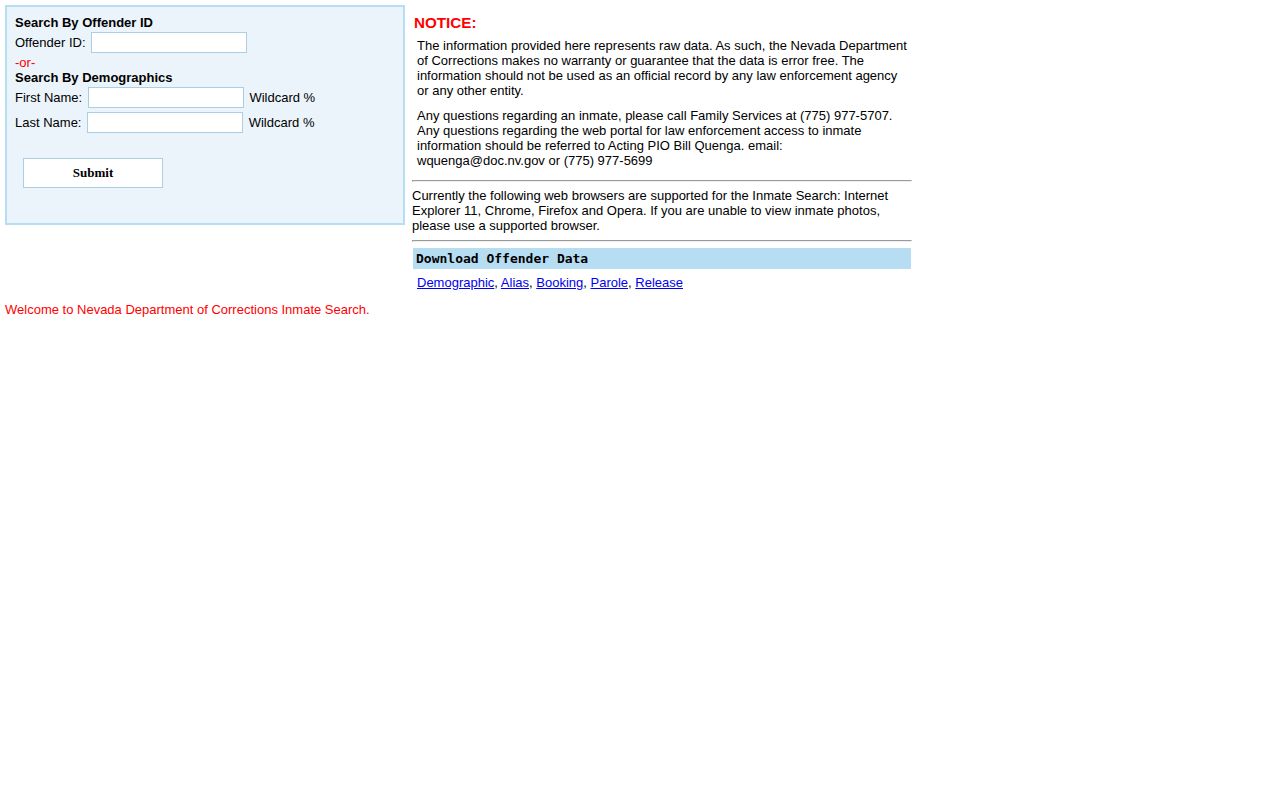
The form serves state-prison records. It does not calculate a county-jail sentence for someone who never entered NDOC custody.
Lander County Jail Date Records
A county-jail sentence remains a local matter unless NDOC takes custody. Lander County's Sheriff and sentencing court hold the useful records. CitizenRIMS can show a historical booking marked Released with an exact out timestamp. That is evidence of leaving the listed county custody event, but the disposition still matters. A transfer to NDOC, another county, federal authorities, or another agency is not the same as community release.
No published Lander-specific good-time policy was verified. Do not apply a state-prison credit formula to a county sentence. Ask Detentions for the jail calculation or release log, and request the signed judgment from the court. Argenta Justice Court handles the Battle Mountain township, Austin Justice Court serves its township, and Lander County District Court within the Eleventh Judicial District handles district-level matters. The docket may also show an amended order or a second case that changes the expected date.
A narrow public-record request can identify the person, booking number, custody dates, and desired calculation or release field. Ask for electronic delivery and a fee estimate. Nevada's public-record framework does not establish one verified flat Lander fee, so no fixed amount should be promised.
Nevada Credits Change Release Dates
NRS Chapter 209 contains Nevada's prison-credit rules. Credits can arise from faithful performance and other authorized activities. Their amount and use depend on the offense date, sentence, exclusions, and the specific credit. Some provisions affect a minimum term, some a maximum term, and some only a particular eligibility calculation. Credits may also be forfeited and, where authorized, restored.
Presentence credit is separate and must be checked against the judgment and agency calculation. Concurrent counts run at the same time; consecutive counts run one after another. Adding a consecutive matter can move a release calculation substantially. The controlling law may be the version in effect for the offense, so a current summary cannot safely replace the judgment and applicable statute.
NRS Chapter 213 governs parole concepts, Board authority, mandatory parole provisions, violations, and discharge. Eligibility still is not a grant. After a grant, NDOC processing and approval of a parole plan can remain. Residential confinement also has a precise meaning: Nevada treats the person as an inmate while supervised in that community setting.
Note: NDOC timekeepers calculate state dates; the Parole Board decides parole matters and does not replace the sentence calculation.
No Universal Nevada 85% Rule
Nevada sentence structure cannot responsibly be reduced to “everyone serves 85%.” Research found no across-the-board Nevada statute requiring every state prisoner to serve exactly 85 percent of every sentence. Nevada uses minimum and maximum terms, concurrent or consecutive structure, presentence credit, Chapter 209 credit rules and restrictions, and Chapter 213 parole law. Offense type and effective date can alter the result.
Federal truth-in-sentencing funding history and another state's rule do not establish the date for a Lander County commitment. Begin with the signed judgment for each count. Identify each minimum and maximum term. Confirm whether the counts overlap or follow each other, then check presentence credit and posted statutory or program credits. Compare that calculation with NDOC's current labels and the Parole Board's exact action.
This is Lander County's distinctive release-date issue. A short percentage rule sounds clear but can create a false date. The safe answer is a documented chain from judgment, through credits and parole law, to the actual agency record.
Changes to Lander Release Dates
Several events can move a projected date. The effect depends on the record and governing law, so each event must be confirmed rather than guessed.
| Change | Possible effect | Best record |
|---|---|---|
| Amended judgment | Changes a term, count, or sentencing structure. | Signed court order |
| Presentence-credit correction | Adds or removes credited custody days. | Judgment and agency calculation |
| Credits earned or forfeited | Changes an eligible calculation under applicable law. | NDOC timekeeping record |
| Parole action | Grants, denies, continues, rescinds, or revokes parole. | Board action plus NDOC record |
| New consecutive case | Adds time after another term. | All controlling judgments |
| Detainer or hold | May cause transfer to another custodian. | Release disposition and receiving agency |
A scheduled person may be removed from a parole hearing if transferred or found ineligible. Late-month decisions can also appear in a later action report. Even a grant can be rescinded before release because of serious discipline, adverse information, or sentence recalculation. Preserve the Board's exact result label, then find the NDOC release row.
Verify Lander County Actual Release
A prediction answers when custody might end. Verification answers what happened. For a Lander County jail event, look for the CitizenRIMS Released status and out timestamp, then confirm the release type or receiving agency through the Sheriff and court. For a state-prison event, the NDOC downloadable release data may contain offender ID, book ID, release date, and release description. The public data still carry NDOC's raw-data warning.
If an automated notice arrives, use the Lander County VINE inmate check process to identify the reporting agency and timestamp. Then call or request the official record. The notice is valuable for speed, but it is not audited by NDOC before transmission and cannot settle every conflict.
A person can leave Lander County custody on the expected day and go straight to another authority. Always record the disposition. “Out” and “free in the community” are not interchangeable. The actual release record, receiving agency, and later court or corrections entry complete the timeline.
Read Nevada Parole Date Records
The Nevada Board of Parole Commissioners publishes hearing schedules, monthly actions, and eligibility lists, but each source answers a different question. An eligibility list is generated by NDOC for scheduling. Inclusion does not grant release. A hearing agenda shows a planned proceeding and can change if the person transfers or becomes ineligible. Monthly action reports state the Board's result, although a late-month matter may appear in a later report.
Preserve the exact action label. Results may grant, deny to a date, revoke, continue, rescind, defer, or take another action. A grant still does not mean the person walked out that day. Nevada's Pre-Release Unit coordinates the parole plan, and approved placement must be in place. Serious discipline, adverse new information, or a recalculated sentence can also lead to rescission before release.
After locating an action, compare it with NDOC's actual release entry and the Division of Parole and Probation record. The Board decides parole matters. The Division supervises and enforces conditions after release. That agency split explains why a Board date and a supervision record can both be necessary without either one alone proving the physical release event.
Resolve Lander Date Conflicts
When two dates differ, list the source, label, and date each record was checked. A CitizenRIMS out timestamp may describe leaving the county jail. An NDOC parole date may describe eligibility or a Board action. A court order may modify the sentence. Once each item is labeled, many apparent conflicts become separate stages of the same custody history.
Ask the agency that created a calculation to explain it. For a local event, provide Lander County Detentions with the name, booking number, court case, and approximate custody dates. For NDOC, provide the offender ID, book information, commitment case, and the precise date field in dispute. Sensitive identifiers should be sent only through a secure channel when required.
Do not treat an automated alert as the correction mechanism. Alerts are designed for notice and can lag. The official jail, corrections, or court record controls its own part of the timeline. A narrow written request creates a clear response and reduces the chance that records from two people with similar names are combined.