
Lander County VINE Coverage
Nevada now directs users to NV S.A.V.E., the state's automated victim-information and notification portal. Older official material may call the service VINE or VINELink. That older name explains why many people still search for a VINE inmate check. The current action, however, is to use NV S.A.V.E. and follow the labels shown in its live interface.
Official Nevada descriptions say participating criminal-justice agencies send county-jail and prison custody information to the statewide service. For a Lander County booking, compare the result's agency with the Lander County Sheriff's Office or Lander County Detention Center. For a state-prison record, look for the Nevada Department of Corrections. Participation and data arrival should not be assumed for every new booking. The service can report a custody status, location, or event, but only the live result establishes which fields are present.
Federal custody is outside this system. A person held for the U.S. Bureau of Prisons requires the BOP locator, while current immigration custody requires the ICE locator. A transfer can also explain why someone is no longer listed under Lander County. It does not, by itself, mean release to the community.
Search Lander County VINE Records
Start with enough information to separate people who share a name. An offender or booking identifier is stronger than a name alone. The agency name is equally important because a Lander County case may move from the county jail to NDOC or another custodian. Use this sequence:
- Open NV S.A.V.E. and choose the person or offender search offered by the current interface.
- Enter the requested name or identifier. Narrow the result by Nevada or agency when those controls appear.
- Compare all available identifiers. Do not select a record only because a common name matches.
- Open the record and read the custody agency, exact status, and event date or time.
- If the status says released, save the agency and timestamp exactly as displayed.
- Confirm the event with the Sheriff, NDOC, or the court that issued the controlling order.
A no-result screen has several possible meanings. The agency may not yet have transmitted the event, spelling may differ, or the person may be under another system. Try a known identifier and reasonable name variants. If the person was booked locally, CitizenRIMS and the Sheriff's Detentions line are the next checks. The full Lander County released inmate search explains those agency-specific paths.
Lander County Release Alert Fields
The live portal controls the exact field set. Do not assume it will supply a release reason, destination, sentence calculation, or court disposition. Record the displayed words without turning them into a broader conclusion.
| Field | How to read it |
|---|---|
| Name or identifier | Helps distinguish the selected person; compare every available identifier. |
| Custody agency | Shows which participating agency supplied the event. |
| Status | May state a custody condition or that the person was released. |
| Location | May identify the reported facility, but availability varies. |
| Event date or time | Dates the automated event and should be copied exactly. |
| Notification options | Shows which alert channels and event choices are offered. |
“Released” should be tied to the reporting agency. It may describe leaving that agency, not necessarily arrival in the community. Another jail, NDOC, federal authorities, or a different hold may follow. Conversely, someone who has left custody may remain absent because the automated record has not caught up. The Sheriff's release record, NDOC release data, and court docket provide firmer context.
The NV S.A.V.E. search landing page is shown below. Its current controls, branding, and prompts should govern each search.
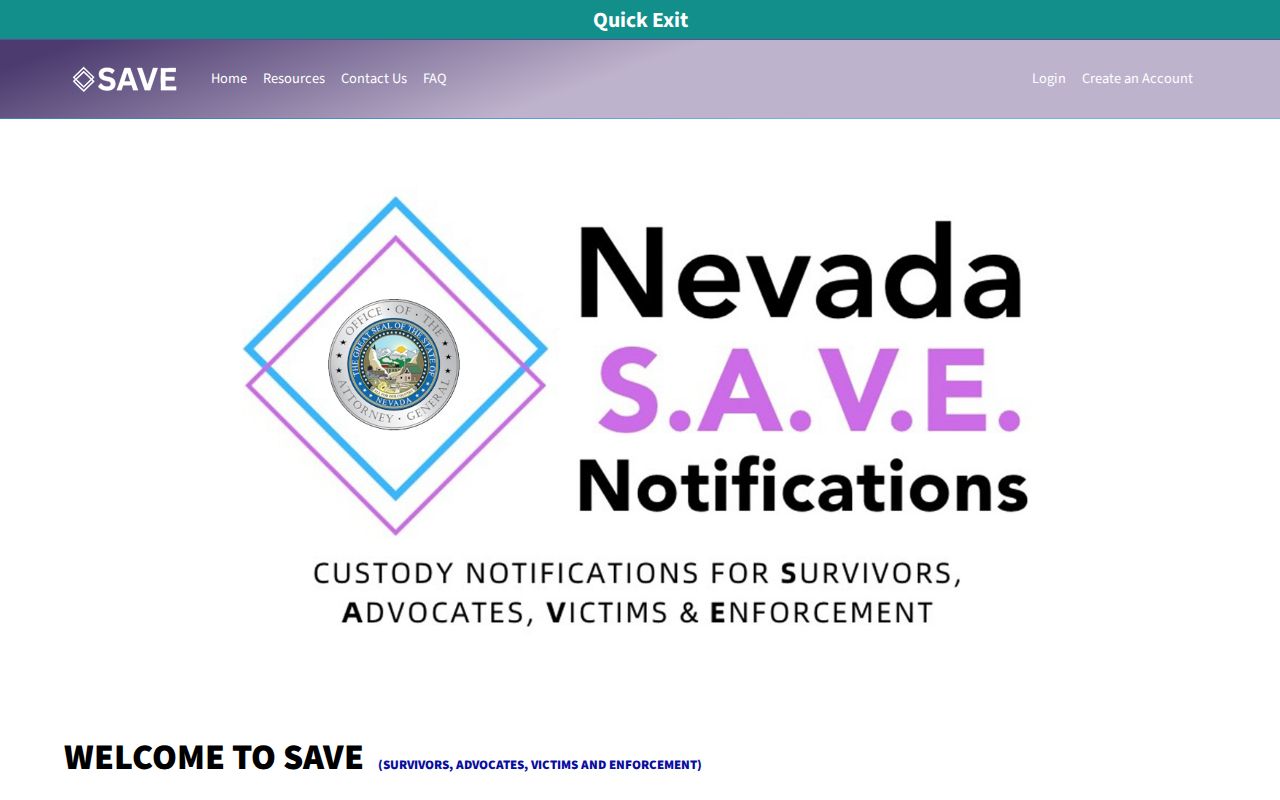
The screen is a starting point for a specific-person check, not an official release certificate.
Register Lander County Release Alerts
Register only after confirming the correct person. NV S.A.V.E. materials describe phone, email, and text delivery, English and Spanish availability, anonymous registration, and custom choices. One registration may continue through transfers among Nevada agencies. Release notices can bypass selected blackout dates, so contact details must remain current.
- Open the correct offender result and select its registration or notification option, or create an account when prompted.
- Choose offered events, including release or custody change when available.
- Select telephone, email, text, or the combination the portal permits.
- Enter and verify the contact channel. Complete any link, code, password, confirmation, or PIN prompt if shown.
- Save the registration and retain the supplied confirmation.
- Update changed contact information. Call 1-866-393-5445 for round-the-clock system help.
Do not invent a four-digit PIN step for the current portal. Nevada's live description emphasizes account creation and delivery choices. A PIN belongs in current instructions only if the interface presents one. An automated alert is useful for quick notice, yet direct agency confirmation remains necessary before making plans based on the event.
Confirm Lander County VINE Results
NV S.A.V.E. is a supplemental alert service. Nevada warns that transmitted information is not an official NDOC record and is not audited by NDOC before transmission. Data can lag, and a missing result does not prove release. Call Lander County Detentions at 775-635-1489 for a county custody event. For a state-prison event, compare the NDOC offender search and request an official record when accuracy is critical.
For a county release, CitizenRIMS may preserve a historical entry marked Released with an exact out date and time. For an NDOC event, public release data may show offender ID, book ID, release date, and release description. Neither source should be stretched beyond its labels. A court docket can show the order that led to bond, dismissal, sentencing, or another disposition.
NV S.A.V.E. does not replace federal locators. It also is not the Nevada sex-offender registry. That registry is limited to people who have a legal registration duty and must not be treated as a general list of released people.
Legacy VINE Alert Differences
Legacy Nevada VINE material used a different telephone workflow. A registrant chose a four-digit phone PIN, and an automated call required that PIN followed by the pound sign. When a call was not confirmed, the legacy service could leave a message and retry for up to 48 hours. Email registration did not use that telephone PIN. Listed events included release, transfer, escape, and death.
Those details explain older instructions found online. They should not override NV S.A.V.E.'s live prompts. Use the current portal's verification method, even when it differs from the brochure. Keeping the two systems distinct prevents a failed registration and avoids telling a user to wait for a prompt that may no longer exist.
Nevada Mailed Release Notices
Automated alerts and formal mailed notices are separate Nevada processes. Qualifying victims of NDOC offenders can register through NDOC Victim Services and Parole Board Victim Services. That registration asks for the offender's full name or NDOC ID, the registrant's relationship, and current contact information. The state expressly describes NV S.A.V.E. as supplemental, not a replacement for this mailed process.
The distinction matters in Lander County. Someone may want a quick phone, email, or text event from NV S.A.V.E. while also needing the formal notice channel tied to an NDOC or Parole Board matter. Register for each appropriate service. Updating an NV S.A.V.E. account does not necessarily update mailed-notice records, and the reverse is also true.
The official distinction is visible on the NDOC notification page captured below.
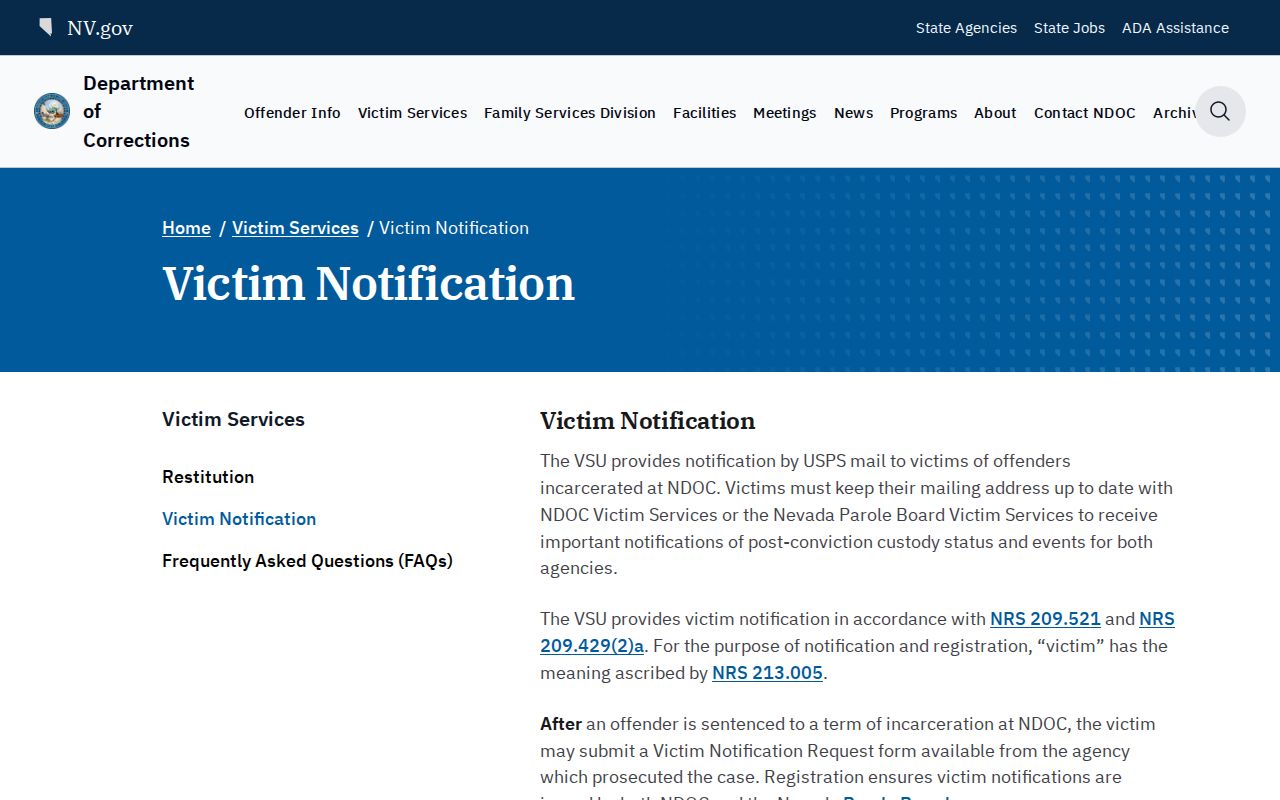
This separate enrollment route is the distinctive Nevada layer that a VINE-only search can miss.
Lander County Agency Fallbacks
When NV S.A.V.E. cannot settle the question, follow the custody trail. A local booking begins with the Lander County Sheriff. CitizenRIMS can preserve a historical Released flag and exact out time long after a person has left the live view. Call Detentions for the specific custody event if the portal and alert disagree. Ask for the booking and release log when a written agency record is needed.
A state commitment requires a different check. The NDOC public search accepts an Offender ID or first and last name. Its downloadable release file can contain offender ID, book ID, release date, and release description. Those fields provide useful evidence, but NDOC's raw-data warning still applies. Family Services can address search errors at 775-977-5707. A parole schedule, eligibility list, or grant is not a substitute for the later NDOC release entry.
Court records explain why custody changed. Argenta Justice Court serves the Battle Mountain township, Austin Justice Court serves its township, and Lander County District Court handles district-level cases within the Eleventh Judicial District. A docket or signed order may document bond, dismissal, sentencing, or another disposition. Match the case number and person before relying on it.
Lander County Alert Planning
An alert should trigger verification, not a fixed pickup plan. Confirm whether the event is release, transfer, or another custody change. Ask the reporting facility for the physical release point and timing when arranging safe transportation. Lander County's official sources do not promise one release schedule, and an automated timestamp does not establish when a person will be ready to leave the facility grounds.
Keep the registration confirmation and note which agency was selected. If a person transfers within Nevada, the registration may continue, but check that the displayed custodian changed. If the person moves into federal or immigration custody, begin using the appropriate federal locator because NV S.A.V.E. does not cover those systems. A gap between systems is not proof that every form of custody ended.
Protect notification access as carefully as other account details. Use contact information that the registrant can maintain, respond to verification prompts, and update it after a phone number or email change. For a formal mailed-notice registration, update the separate Victim Services record as well. Each system depends on current contact data.