
Lander County Parole vs Probation
Parole and probation can both require a person to report to the Nevada Division of Parole and Probation, but they start in different ways. Parole is a conditional release from an NDOC prison sentence. The Nevada Board of Parole Commissioners decides parole matters, and the Division supervises the person once release occurs. Probation usually comes from the sentencing court instead of a Parole Board grant. In a Lander County case, the court docket, judgment, probation order, and later discharge or revocation order provide the core judicial record.
The distinction affects where to verify the status. A Board action may show that parole was granted, denied, deferred, continued, revoked, or otherwise considered. It does not by itself establish the day a person physically left prison. For probation, the signed Lander County court order is more useful than a parole schedule. In either case, the Division identifies the proper supervising office and handles reporting or enforcement questions within the limits of what it can disclose.
| Feature | Parole | Probation |
|---|---|---|
| How it begins | Conditional release from an NDOC prison term after Board action and release approval | A sentence or order entered by the court |
| Decision record | Parole Board action plus the NDOC release row | Judgment, probation order, and court docket |
| Supervision agency | Nevada Division of Parole and Probation | Nevada Division of Parole and Probation |
| Proof it ended | Discharge or final supervision record | Court or supervision discharge record |
- Parole
- Release from prison under stated conditions while part of the sentence remains active.
- Probation
- A court-ordered community supervision term, often imposed instead of part or all of a jail or prison term.
- Discharge
- The formal end of a sentence or supervision obligation, as shown by the responsible agency or court.
- Absconder
- A supervision label for a person alleged to have stopped reporting or whose location is unknown.
Verify Lander County Post-Release Supervision
Start with the record tied to the sentence. For someone who served a Nevada prison term, the NDOC Inmate Search accepts an Offender ID or first and last name and supports a percent-sign wildcard. Its profiles can retain released people. Observed records used institution or status values such as PAROLE and INACTIVE-DSCHREL. The public system is raw data, however, and NDOC warns that it is not an official record. Compare identifiers and read the booking, parole, and release categories rather than relying on a name alone.
Then trace the decision and actual release as separate events. Monthly Board actions are stronger evidence of the decision than an eligibility list or hearing schedule. NDOC release information is the better source for the custody event. Finally, the Division of Parole and Probation can identify the correct district office for a Lander County release and address supervision questions.
- Identify whether the sentence came from a Lander County court or NDOC state-prison commitment. A county jail exit alone does not establish parole.
- Search NDOC by Offender ID when known. Compare the name, photo, aliases, institution, sentence rows, parole rows, and release rows.
- Review the monthly Parole Board action reports for the exact action and date. Do not treat an eligibility list as a grant.
- Confirm physical release in NDOC release data. A grant may still depend on an effective date, sentence calculation, or approved release plan.
- For probation, obtain the Lander County docket and signed probation order from the correct court clerk.
- Contact Nevada Parole and Probation to confirm the proper office and ask what status information may be disclosed.
For the local jail record and court-confirmation route, use the Lander County released inmate search. That path helps distinguish bond, time served, probation, transfer, and other dispositions before a supervision inquiry begins.
Lander County Parole Agencies
Nevada deliberately splits parole work between two agencies. The Nevada Board of Parole Commissioners holds hearings and decides parole matters. The Nevada Division of Parole and Probation, part of the Department of Public Safety, supervises people and enforces conditions. The Board states that it does not employ the sworn officers who perform that work. Warrant and violation-enforcement questions therefore belong with the Division, not the Board.
Monthly schedules are arranged by institution and date after agendas are finalized. A name can be removed because of a transfer or a change in eligibility. Eligibility lists are generated by NDOC for scheduling and are not final decisions. Board action reports can also lag at the end of a month, and eligibility dates may change. Those limits make a three-record check essential: Board action for the decision, NDOC for actual release, and Parole and Probation for supervision.
The official Board hearings hub shows how Nevada organizes these proceedings:
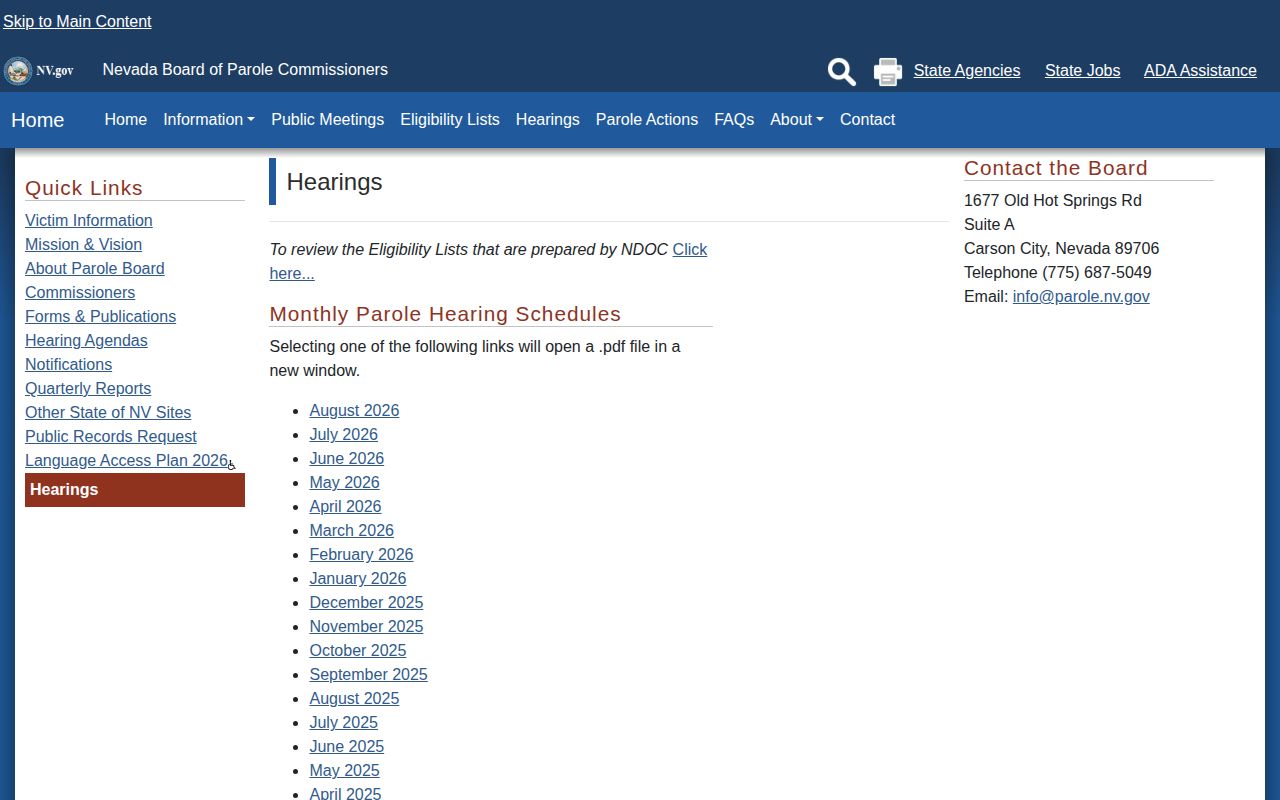
The screen is a hearing-navigation source, not a release certificate. Follow any listed matter to the Board action, then compare that result with NDOC’s custody and release data.
Note: A parole hearing, eligibility entry, or favorable action never replaces confirmation of the actual NDOC release event.
Lander County Supervision Contacts
No research source verified a dedicated Lander County Parole and Probation office address or local office hours. The accurate route is to use the Division’s statewide contact system and ask which district currently handles the released person. Call before traveling. A release address or approved placement can affect assignment, so the commitment county alone may not identify the active office.
Nevada Division of Parole and Probation
Official agency website
Supervises Nevada parole and probation cases
Ask for the correct district office and current public contact route
Nevada Board of Parole Commissioners
1677 Old Hot Springs Road, Suite A
Carson City, NV 89706
775-687-5049
info@parole.nv.gov
The Board contact is useful for hearing records, action terminology, and public schedules. It is not the reporting office for a person on parole. For questions about a particular NDOC public-search record, Family Services can be reached at 775-977-5707. Keep each inquiry narrow and provide an NDOC ID when available.
Lander County Supervision Violations
A violation allegation does not automatically end supervision or prove a new offense. Parole violation agendas concern a person accused of breaking parole conditions. The Board may continue or revoke parole after findings. An agenda records a proceeding, not its final result. Probation violations return through the sentencing court, where the docket and signed order show what the judge decided.
An absconder label generally means the agency alleges that a supervised person stopped reporting or cannot be located. It is not the same as a court conviction. Questions about a Nevada parole warrant, enforcement step, or reporting duty belong to Parole and Probation. If custody may have resumed, check the responsible jail or NDOC system as well. NV S.A.V.E. can provide a custody-change clue for participating agencies, but automated notices are not official records and should prompt direct verification.
Common conditions can include reporting, approved residence, travel limits, treatment, fees, or rules tailored to the judgment and supervision plan. The signed order and current instructions control. Do not infer one person’s terms from another case or from a generic list.
Lander County Reentry After Release
NDOC’s 2026 statewide reentry resource manual contains a Lander County column. That local detail matters in a rural county. It identifies Battle Mountain family and food resources, Frontier County Action Agency Family Resource Center, the Lander County Community Health Nurse, New Frontier Treatment Center, non-emergency transportation, and Silver Rider.
These listings support practical needs after release, including food, family support, health care, treatment, and transportation. They do not confirm parole, probation, or compliance. Contact each provider to verify current hours, eligibility, service area, and appointment rules. A supervised person should also clear residence or travel questions with the assigned officer when the supervision plan requires approval.
Note: Resource listings change, so confirm access directly and keep supervision reporting separate from requests for community aid.
Lander County Release Property and ID
Lander County’s official pages do not publish a property-pickup schedule. For belongings connected to a specific detention event, call the Sheriff’s Detentions line at 775-635-1489. Ask where and when property can be collected and what identification is required. Do not assume a routine used by another Nevada jail applies in Battle Mountain.
If identification must be replaced after release, the Nevada DMV identification-card page provides the statewide document and application path. This step can help with ordinary personal records and services, but it is separate from proof of supervision. Errors in a Sheriff release record should go first to the Sheriff’s records custodian. Errors in an NDOC public profile should go to NDOC Family Services.
Lander County Supervision Discharge
Supervision ends through a formal record, not merely because an expected date passes. For probation, look for a court discharge, completion entry, or later order in the Lander County case. For parole, use the responsible Nevada agency’s discharge or final status record. Early-discharge and condition-modification proceedings can also document a change, but the filed outcome controls.
NRS Chapter 213 governs Nevada parole authority, eligibility, violations, and discharge. The judgment and offense law still matter, and no single formula fits every conviction. A person may complete active reporting while another legal obligation remains, or may face a separate case in another jurisdiction. Verify the exact term that ended and the record that ended it.
A clear status check therefore finishes with the originating record: NDOC and the Division for parole, or the court and the Division for probation. Record the agency, date, and exact status wording. That is more reliable than treating silence in a portal as proof that all supervision has ended.